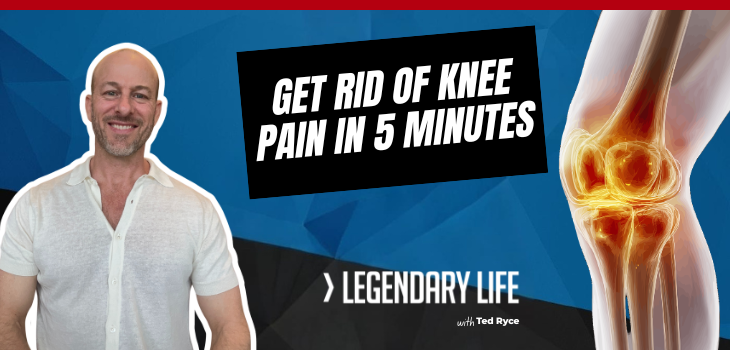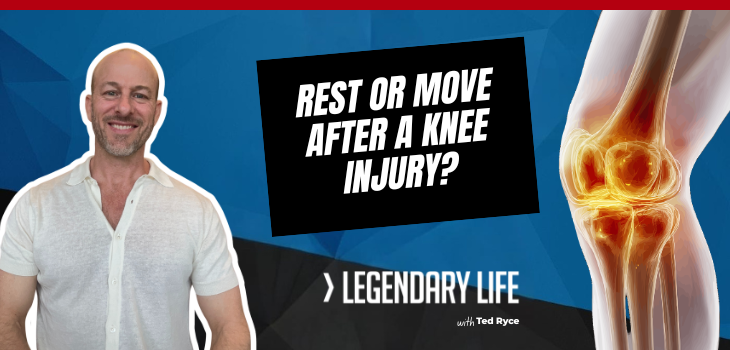
Knee injuries can leave active men stuck between two bad options: resting too long or pushing too hard.
In this episode, Ted explains why most soft tissue injuries need the right amount of movement, how flare-ups happen, and how the three-out-of-ten pain rule can guide smarter training after an injury. Listen now!
You’ll learn:
- Why complete rest can lead to weaker muscles, tendons, ligaments, and cartilage
- How pushing through too much knee pain can trigger flare-ups and delay progress
- How to use the three-out-of-ten pain rule during exercise and the next morning
- Why rebuilding knee capacity requires the right progressive training plan, not just anti-inflammatories or passive treatments
Chapters:
(00:00) Introduction
(01:36) Common Knee Injuries 06
(02:10) See A Doctor First
(03:10) Why Rest Fails
(05:24) Pushing Causes Flareups
(07:48) Finding the Right Load
(09:10) 3 Out Of 10 Rule
(11:55) Load Management Basics
(12:19) My Knee Rehab Example
(14:34) Exercise Beats Quick Fixes
(15:25) R3 Knee Method Offer
(16:16) Final Wrap Up
Related Episodes:
Meniscus Tears: Is Surgery or Physical Therapy The Best Option?
Ask Ted: How to Train Smart with a Knee Injury (and Still Make Progress After 50)
How To Get Back in Shape and Train Smarter After an Injury
Links Mentioned:
Connect with Ted on X, Instagram, Facebook, LinkedIn
Podcast Transcription: The 3-10 Knee Method: Should You Rest Or Keep Moving After A Knee Injury? Use This Simple Rule - Part 3
Ted Ryce: So should you keep exercising or should you rest after a knee injury? That's what we're gonna cover today. And welcome back to the podcast. If this is your first time tuning in, I'm Ted Ryce, an executive health coach who specializes in helping men over 40 get back into the best shape of their life, especially if you're suffering from injuries.
That's my specialty. So let's get into it. While we're really gonna kind of focus on knees, the same principles are gonna be true. So some of the most common injuries that happen are sprains, strains, and tendinopathies. With knees, you also have injuries to the soft tissues, like the meniscus, or injuries to the ligaments, like the ACL.
And one of the most common questions that I used to ask myself is, should I rest it? Should I keep moving? Should I do some exercises? Which exercises should I do? So first of all, before we get into this, do not try to diagnose yourself. If you have a serious injury, go to the freaking doctor. Yes, some doctors, they're annoying, and you can't take what a doctor says all the time.
Uh, l- let's put it like this, you know There's some issues with some- what some of the doctors say, right? Depending on how good the orthopedic doctor is that you're seeing, and make sure you go to a specialist, not a GP. But once you realize or get the, the diagnosis and it's not like, okay, whoa, this is a major injury, we need surgery, we need this, right?
Once you know it's like, well, take some anti- anti-inflammatories, maybe do some physical therapy, or maybe do some rest, or maybe avoid squats. Once you get that, then it's like, okay. That's not, that's not what doctors are good at by the way, but what they're really good at is ruling out like a major situation that needs immediate medical attention.
And so complete rest, after you rule out major injuries, complete rest is not required for the vast majority of soft tissue injuries. In fact, research shows that for most injuries, complete rest leads to worse outcomes, longer recovery times, more time out of activity, more time out of sport. But if you go too far the other way and you're pushing through significant pain, you can also create a lot of flare-ups where you have to take a couple days off.
And so what happens if you rest too much after an injury? Well, think about it like this. What happens when you stop exercising? You lose muscle, you lose conditioning, and specifically for injuries, joint injuries, your tendons will get weaker, your cartilage gets weaker. In fact, uh, so what I'm saying is, not only do your muscles get weaker, not only does your heart get weaker But the tendons, the ligaments, the cartilage also decondition too.
And what's different about this is that, and you've probably noticed this if you struggle with injuries, it's really easy to get the muscles strong. The muscles respond, and it can be r- feel really good when you're working the muscles. And then maybe later on that day or maybe you wake up the next morning, you're like, "Ow, my joint hurts.
My muscles kind of actually feel a little, maybe a little bit good, but ooh, inside the joint." So if you're not loading the joint, everything gets weaker, and the weaker you get, the harder it becomes to return to the things that you wanna do, whether that's just playing with your kids, whether that's with walking, hiking, taking tours around Europe where you're getting 15 to 20,000 steps a day in, or whether it's playing a sport like I do, whether it's going back to golf, tennis, or Brazilian jujitsu in my case.
And so it's really important that as soon as you can, you start loading the tissue, you start getting back into shape. But what happens if you push through pain after an injury, if you push too much? This is the other side of the spectrum. You can create a flare-up. And what ends up happening, and you probably felt this, is that you need to rest after a flare-up.
And during a flare-up, uh, 'cause I'm dealing with... I, I have... Most of my clients have injuries either from, you know, previous situations. I got a client who tore a hamstring, uh, playing tennis competitively. Um, not, not, she's not a pro, but she f- plays tennis like one. She's got the same, same schedule anyway. So we've had to be very careful in approaching her, I don't wanna call it rehab because I'm not a medical professional, but training her through this injury until the injury heals, right?
Helping the injury heal and reconditioning her to get her back on the tennis courts again. And so we have to be very careful. In fact, she was working with a physical therapist And I took over her rehabilitation for lack of, you know, don't come after me. I'm, I'm not doing rehabilitation, you know, wink, wink.
But, um, her physical therapist re-injured her by doing a massage directly to that injured area in the hamstring. So whenever a flare-up happens, whether it's from shitty physical therapy like my client was experiencing... And by the way, my client's, uh, wealthy. She... And, and she lives in an affluent area, so this, this guy is working with, um, affluent clientele, but still not very good.
So just because you're paying a lot of money or in a good area doesn't necessarily mean that you're working with someone good. You know you're working with someone good because flare-ups don't happen, or if they do, there's a reason for it and you can adjust, right? I'm not gonna say I never have flare-ups with a client.
Sometimes it happens, but we know why and what to do after. But if you're in a cycle where you're constantly pushing and creating flare-ups and then you have to take rest, what happen? The same thing happens as taking too much rest, right? You start to decondition, especially the pain. Or, you know, if there's swelling, it can cause inhibition of the muscles.
In other words, the muscles stop working, right? So how much load is just right? Well, that is, that is the million-dollar question, right? And so we know that putting the right amount of load... We know from research, by the way, that putting the right amount of load through healing tissues promotes the formation of a strong scar, retains as much strength as possible, and gets you back to doing whatever activities or sports you were doing.
And also, and, and I teach my clients this because sometimes, you know, it's like clients ask, "Hey," uh, they, they, they think I have a magic answer, and I do. My magic answer is, "Hey, we have to use your pain." In fact, sometimes I don't cl- call it pain with clients. I got one client, we're calling it brain signaling because he was, he's, uh...
I'm helping him through a knee injury, and he was telling me, he's like, "Well, it's not really pain." I'm like, "Yeah, but it's a signal from your joint to your brain, okay? And it's information. Whether it passes the threshold for you to label it pain or not Is a subjective thing, but if you're getting some type of signal from your knee, then that is, that's information that you should pay attention to.
And research shows that about a 3 out of 10 rule is a good guide, where let's say zero is completely pain-free, 10 is just like take me to the hospital. And so it's called the 3-10 rule, and the 3-10 rule is your pain shouldn't go above a 3 out of a 10 during activity or exercise. So if you're walking and your pain starts to go to a four or five, you stop.
If you're doing some type of leg exercise and your pain starts going above a 3 out of 10, like a four or a five or a six, you stop. And also your pain shouldn't go above a 3 out of a 10 when you do a cool down after an activity or exercise. And, and for those of you who have dealt with injuries, it probably, like this is gonna feel super, super familiar to you.
Let's say you get in there, you're warming up, and you're feeling good, then you push yourself and no pain. But your body starts to cool down, and in a couple hours you're like, "Oh, my knee feels like, oh man, it, it kind of hurts now. I, I, I didn't realize it because of all the feel-good chemicals coursing through my brain and body when I was training, but, uh, I kind of over-overdid it."
That's again, a sign you've got, that, that you did too much. And number three is your pain shouldn't feel any worse than usual on the morning after, okay? So 20, roughly 24 hours after. Shouldn't wake up and be like, "Ow, man, I got through the workout. I felt pretty good. But man, today I'm gonna have to be careful.
I'm not gonna be able to get my 10,000 steps. You know, I gotta be really careful today." Like, it shouldn't feel like that. If any of those things are happening, you are doing your, your program sucks. Either you're following the wrong program, I don't care who gave it to you, uh, can be the world's best physical therapist or orthopedic surgeon or injury rehabil- you know, post-rehabil-rehabilitation expert.
That's what I guess I would call myself. And it doesn't matter if it's making you worse, that is the only data that you need. Or if you're following it incorrectly, which could also, you know, it's also important to be honest about that. Like maybe you don't know how to follow it correctly. So the 3 out of 10 rule, the or 3-10 rule, it's gonna help you Take responsibility for when to push harder, go a bit longer, or if you've overdone it, you can ask why and, you know, make sure you don't do it again.
And what we're talking about here is load management. Now, you probably never heard that super unsexy term, but load management has to do with how... not, not just, not just the workout, but, you know, all the variables in the workout and all the variables during the week, like how many times you're doing it.
Maybe, for example, I was doing-- I hurt my-- Ironically enough, I hurt my knee about a month ago. Uh, I wasn't sure. I slipped and fell that night, but I also did two hours of jujitsu that, earlier that day. I didn't feel my knee until I woke up the next morning, and my knee was swollen and painful. And so anyway, what I'm doing is that I'm making sure that when, when I first started, so I'm making sure that I'm loading it properly, uh, lo- managing the load properly.
So when I first started my knee rehab, which thankfully I'm really great at, in particular with knees, I started out with three times a week, but now I backed off to two. Why? Because the three out of ten rule. It's like I'm getting be-- It's not about what an expert tells you, it's about the response that your body is giving you.
Experts have expertise, they have experience, but I can't magically know that your body is gonna respond well to three or five or two, right? We have to experiment. And I started noticing I'm getting better performance and less pain when I backed off to two times per week because the intensity of my, what, what you would call knee rehab, has increased, okay?
And so anyway, coming back to, like, answering this question, you know, balancing activity, should you rest? Should you push? Use the three out of ten rule to help you, okay? And again, first get cleared by a medical professional. You need to know how serious that your injury is. Go to a doctor. Doctors can be great, they can be annoying, but they're extremely skilled at ruling out something that needs immediate medical attention.
And when they send you off with, "Oh, well, just, uh, stay off of it for a few days and take some, you know, Advil or Aleve, or here's some," you know, what-- I forget the, the prescription strength anti-inflammatories that they're using now, then you know, like, "Okay, this guy is, uh, th- he doesn't know what to do here."
And by the way, I won't get into anti-inflammatories. Uh, maybe it helps you get out of pain fast, but it does not solve the problem. The problem you need to solve is building tissue tolerance, capacity, strength in your muscles, tendons, cartilage, ligaments with the right progressive program.
Anti-inflammatories will not fix your knee. Surgery won't even fix your knee 'cause you gotta do re- uh, you have to do physical therapy after the surgery, right? It's always about the exercise. It's always about the exercise, not the massage or chiropractic or even stem cells. "Hey, I got stem cell injections."
It is about the exercise and rebuilding that capacity. So that's it. Use that three out of ten rule to help guide the way. And I wanna tell you something. If you're a high-performing professional and you don't wanna mess around with trying to figure this out on your own because you've already kinda done that, I've created the R3 Knee Method where I'm gonna help you restore, rebuild, and return to the activities and sports that you love doing, right?
And again, if you're a high-performing professional, you're doing well financially, and you're, you've seen some pr- other professionals, they haven't really helped you, go ahead and go to legendarylifepodcast.com/knee, legendarylifepodcast.com/knee and book a call with me, and let's talk about your situation, and I'll let you know if it's something I can help you with.
Have a great one. Hope you got a lot out of this episode, and I'll speak to you on the next one.
Sign up to receive email updates
Enter your name and email address below and I'll send you periodic updates about the podcast.