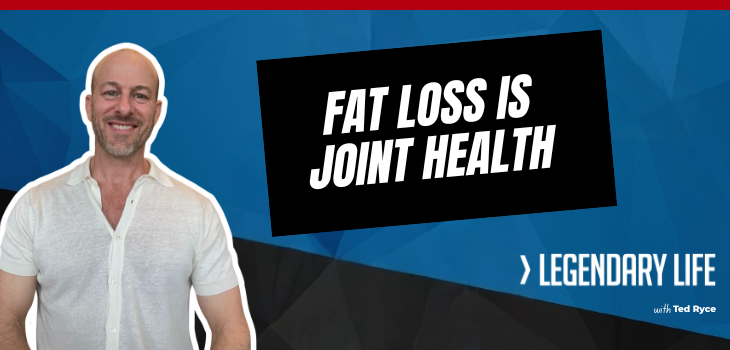
Most men over 40 think their aching knees, shoulders, and low backs are just the price of getting older. They’re not.
In this episode, Ted makes the case that fat loss might be the most underrated joint treatment there is — and not just for the obvious mechanical reason.
Yes, every pound of extra weight pounds your knees with roughly four more pounds of force per step. But the part almost no one talks about is what body fat does chemically: it drives the low-grade inflammation that breaks tissue down and stalls healing — even in joints that bear no weight at all, like your hands.
Ted walks through the science joint by joint, why it’s central to his R3 Method, and why leaning out is often the fastest way to get your body to stop hurting.
You’ll learn:
- Why each pound lost can reduce the load on the knees by roughly four pounds per step
- How excess body fat can affect joints through both mechanical stress and systemic inflammation
- Why the shoulders, hands, and other non-weight-bearing joints may still be affected by excess body fat
- How protein intake, daily movement, metabolic health, and pain monitoring can support joint recovery
Chapters:
(00:00) Fat Loss Saves Joints
(00:33) The Knee Force Stat
(02:12) Why Pain Feels Normal
(04:31) Mechanical Joint Load
(06:43) Inflammation Hits Hands
(07:25) Fat as Endocrine Organ
(08:29) Metabolic Health Heals
(10:39) R3 Method Overview
(13:12) Client Wins Motivation
(17:00) Actionable Takeaways
(18:42) Wrap Up And Next Steps
Related Episodes:
Can Visceral Fat Affect Your Joint Pain? (And What To Do About It)
Ted Talk 225: Does Weight Lifting After 40 Harm Your Joints? – Ask Ted
Links Mentioned:
Legendarylifepodcast.com/knee
Connect with Ted on X, Instagram, Facebook, LinkedIn
Podcast Transcription: Fat Loss Is Joint Health: The Real Reason Your Knees, Shoulders, and Back Ache After 40
Ted Ryce: So here's a stat that should stop you in your tracks. For every single pound of extra weight you carry, your knees absorb about four extra pounds of force with every step. So if you're carrying 20 extra pounds, that's 80 pounds of pressure pounding your knees all day, every day. But that's not even the part that got me, because here's what nobody talks about.
Your body fat doesn't just crush your knees because of the weight. It's quietly attacking your shoulders, your low back, and get this, even your hands, joints that carry zero body weight. And once you understand why, you'll never think about fat loss as just aesthetics again. Welcome back to the Legendary Life Podcast.
I'm Ted Ryce. In this episode, I'm gonna make a case that might change how you see your own body, that fat loss, it's one of the most powerful joint treatments available, and it's basically free. We'll go joint by joint, knees, shoulders, low back, and then I'll show you hand arthritis research that proves this just...
It's not about just the weight pressing you down, it's about what fat is doing inside of you chemically. Stick with me because the second half is where this is really gonna get interesting. So why do so many men over 40 accept aching joints as normal? I don't know about you, but when I was in my 20s, I remember guys, especially in the gym, talking about how they were stiff all the time and that it was because they were getting old, and wait until you're my age.
And they got cortisone injections, took Advil and Aleve, and basically started to avoid the exercises that were causing them pain, and their lives started to shrink around them, right, and their symptoms. And a lot of pain, it's not a life sentence, even though it might feel like it is. It's a modifiable physiological state.
And how much fat you're carrying, it's one of the biggest levers that you can adjust how much pain you're feeling, what your function is. So- Again, one of the most important lessons I want to teach you about longevity that I feel nobody is talking about is if longevity is your goal, getting into the best shape possible is the number one thing you want to do for longevity.
You can take all the stem cells, and supplements, and peptides, and whatever you want to take, but if you're, if, if you're, if you don't have muscle, if you're not able to produce force with that muscle, in other words strength and power, if your cardiovascular system is weak, none of that other stuff's gonna matter.
Okay? So we know that. That's not debatable or even really argued. But what people aren't talking about is like, man, especially I was thinking for myself, I've got a bunch of injuries. How am I gonna stay functional? How am I gonna keep my VO2 max high? How am I gonna keep my grip strength strong, my leg strength strong?
And You can get stuck in this vicious loop, pain, less movement, also avoiding movement, avoiding lifting certain things, and then you start to put on more weight, and then you get into more pain. Man, it's a really bad cycle. So let's start with the part you probably heard about, the mechanical side, because the numbers are genuinely wild, and it's not just the knees.
So what does extra weight do to your joints mechanically? So in older adults with knee osteoarthritis, there was a research study done by Messier, if I'm saying his name correctly, in two thousand and five, and what they found was for each pound of weight lost, they had a four-fold reduction in the load on the knee per step.
So in other words, if you lose ten pounds, that's forty pounds less through your knees on every step. And what this does is it improves pain and function. That's what they found in the study. Another thing is that extra abdominal weight can pull your pelvis forward. If you ever seen someone with a big belly, and you kinda see, like, how that is pulling their skeleton into a weird posture.
I don't wanna get into posture, by the way. That's another whole can of worms. But it can put you in a position where your low back flares up. Carrying less mass through the trunk reduces compressive and shear stress on the spine, right? If, if you wanna put compress-- Uh, I wanna say that again. Putting compressive and shear force on the spine because you're doing sit-ups and a back squat is very different than walking around with a big belly that causes that all day.
Now let's talk about shoulders. Your shoulder doesn't just hold up your body weight, or it doesn't hold up your body weight unless you're walking on your hands. So why does it get better when you lean out? It's because it's not just about the mechanical load. Joints like shoulders and even hands can develop arthritis and pain just because the inflammatory state in your body.
So let's talk about this. Again, going back to that idea about knees, I think it's really an obvious one. It's like, well, you, you're fat, and you're walking around on your knees. Of course your knees are gonna hurt. You're, you're, like, forty pounds. You got forty pounds of fat you're walking around with. But here's something interesting.
A large population study, cohort study, found that obesity was significantly associated with hand osteoarthritis. We're talking about two and a half times higher risk versus normal weight. And that's just one, right? That's just one study. There's so many studies on this. And it's really clear, although the exact mechanisms are still being worked out, but- it's really clear and safe enough to say like, oh, fat is causing inflammation, and we already know that, but it's causing inflammation that breaks down joints And what I want you to-- maybe this is your first time hearing this, but body fat isn't just storage for extra calories for the famine that will never come, really.
We better hope it never comes. It's an active endocrine organ. What does that mean? What i- what is an endocrine organ? It means it pumps out chemicals. And in this case, it pumps out inflammatory chemicals, adipokines, cytokines, like, uh, interleukin six, uh, tumor necrosis factor alpha. So these things that create low-grade body-wide inflammation that leads to the degradation of cartilage, and if you're trying to heal from an injury, probably stalls healing as well.
And this is why some guys do everything right in the gym and/or in their rehab program but still don't get better. They're trying to rebuild tissue or heal tissue in an environment that's actively tearing it down. And this is one of my core philosophies, good health drives healing. So when I get a client into my program and they're suffering from injuries, which is really the direction I'm going in here.
I've, in the past, just a quick aside, focused very much on body transformation, uh, which is a lot of fun helping people, but where my skill set is and, to be honest, what I'm really excited about, is helping people with injuries. I feel like there's a lot of good information out there on body fat reduction, and, uh, what I teach is as good as the best people out there, provided you're not trying to step on stage in a, in a bodybuilder competition, of course.
But where the industry is really falling short, and I'm talking about physical therapists and just the whole, like, injury management, injury treatment from orthopedic surgeons to chiros to physical therapists to, you know... And even me in the past, it's like I started getting into this, I wanted to-- I started getting into this to fix myself, right?
And I was like, "Man, people suck." And I saw some really good physical therapists. But, um, point being, it's like this is one of the things that they're not talking about. Good health drives healing, and more specifically, insulin resistance or metabolic dysfunction, right? Those are two different, uh, two different terms for basically the same state.
It drives inflammation in a way that will cause more pain and cause degeneration of your joints. It'll cause arthritis specifically. So fat loss is not vanity For some joints, it's mechanical relief for your knees, back, hips, and it's putting out the inflammation fire in your joints as well, including your knees and back and hips, but also even in your shoulders, elbows, and hands, which is exactly why it's the foundation of the first phase of my method, the R3 method.
So how does this fit into actually getting out of pain? Well, when I get... I'll, I'll use, I'll talk about, like, how I work with clients 'cause I think that's the easiest way to understand this. So when I, when I get a client that comes to me, and let's say they're dealing with a knee injury, I'm amazing with knee injuries.
I'm s- really solid with shoulders, low backs, hips Um, but amazing with knee injuries. So the R3, by the way, stands for restore, rebuild, and return. And that restore part, it's like, I wanna know. We look at a client's blood work because that's how you measure insulin resistance. We run fasting insulin, we run fasting glucose, we, we run, uh, hemoglobin A1c.
Those are markers of blood sugar. You can't just do hemoglobin A1c and, um, fasting glucose. That's my personal belief. You really need fasting insulin so you can calculate your insulin resistance score. And you gotta look at triglycerides. You gotta look at blood lipids too, and that gives you an, uh, uh, an idea like how metabolically healthy is my client here.
Also, it's like, uh, we need your BMI, which is easy to figure out, but more, uh, w- even better than that is looking at your body fat test, so we can see, like, well, what's your body fat test, right? What's your body fat percentage? How much muscle mass do you have? And also, I wanna know, what are other symptoms you're having, right?
What's your sleep like? What's your stress levels like? What are your stress levels like? It's a little bit early here, and I watched a soccer game last night, or futebol as they call it here in Brazil. But, uh, had a few drinks, speaking of inflammation and poor health, right? But this is how we start with clients because this is gonna affect...
Y- yeah, you can have a great program, but your health, your o- your overall health is gonna affect how you respond to your program, how well you recover from it, how well you progress, because clients who are healthy can progress very quickly. Clients who are drinking too much alcohol, they got too much body fat, they're stressed like crazy, th- they're gonna have a harder time recovering.
And I also wanna tell you this, I don't wanna go off on too much of a tangent about this, but you really have to... This is what I learned from working with clients for twenty-seven years. You really have to... Well, I'll, I'll say it like this, reward and punishment drive behavior. So what I try to do when I work with a client, I give them rewards.
Rewards, it's pretty easy if you can design a good program. Let's say I, I have a c- a client that just started with me a few weeks ago. He's been in chronic shoulder pain for I don't know how long, years. And he had a shoulder surgery. I gave him some exercises. Now, I wanna say something. This doesn't always happen, but it feels so good when it does.
I gave him s- some exercises. The first exercises that we started out with, he's out of chronic shoulder pain in a matter of weeks. Now, it doesn't mean that he's completely healed and, you know, if he does something like throw a, throw a ball or something like that, he's gonna be fine, or if he falls on his shoulder.
But That, let me tell you something, 'cause this guy in particular, he didn't wanna work with me. Oh, well, um, he did wanna work with me, but he's like, "Man, this is more money than I thought it was gonna be," and, you know, "Is this really gonna be worth it?" And now he's totally sold. He's like, "Man, this is amazing.
I can't believe I'm out of pain in two weeks." Right? And he's lost seven pounds in two weeks, too, and he's feeling a lot better. So reward drives behavior, so I give clients wins when they first join because it's like, "Oh, man, is this gonna work? Oh, I feel a little buyer's remorse. Am I stupid for hiring a coach?
I mean, can't I just figure this out on my own?" It's like, no, you can't figure it out on your own. It's taken me twenty-seven years, uh, to... Of, of learning, spending tens of thousands of dollars learning from top experts. You're not gonna figure it out by listening to Andrew Huberman podcasts and watching a few YouTube videos.
All right? Now, some coaches suck, though. But anyway, like, reward drives behavior, so it's really important that when you, when you start ma- And also, one other thing,/
We gotta, you know, progressively load him. But the symptoms he was experiencing changed dramatically in a matter of weeks. Okay? Not every client is like that. That's another important point in the whole framework. Why am I saying that? Because if you're trying different things, you're... Let's say, uh, oh, I got a shoulder injury.
L- We'll, we'll use this example. Let's Google best shoulder exercises for shoulder pain, and then you try a few, and you're like, "Okay. Well, some of those actually hurt my shoulder. I didn't really feel a difference on the others." Or maybe you even did feel a difference, but then you tried going back to playing tennis or swimming or, you know, using your shoulder in a way that triggered it before and caused a flare-up, and now all of a sudden, you're flared up again.
And you're like, "Ah, okay, so those exercises help, but maybe my shoulder's just broken." Right? Anyway I hope that last part was helpful. I know it was a bit of a tangent, but I'm just trying to share, like, how I look at these situations so that you can see yourself in them and start to make better decisions.
So here's what I want you to do. Here are some action- actionable takeaways. Number one is reframe the goal. You're not just lo- losing weight to look better, though you will. You're taking mechanical load off your knees and back and lowering the inflammation that is not just hitting your shoulders, hands, and other joints, but is causing inflammation in other tissues as well, like your arteries, your, your cardiovascular system, raising blood pressure.
And another actionable takeaway is win the mornings first. Pick one high-leverage change that you can do. For example, eating a high-protein breakfast, eating somewhere in the neighborhood of fifty grams of protein in the morning will help satiate you and help you start the day strong. Another one is move daily.
Get your steps up. Now, this can be a, a little bit tricky if you're dealing with a knee, hip, or ankle injury, but it's one of the simplest levers for both fat loss and joint health, right? Keep in mind, use that same ten-three rule, or I'm sorry, three-ten rule, I'm messing up my own rule here, that I've talked about in other episodes where if your pain goes above a three out of a ten while you're doing the exercise or after you cool down or the next day, then you overdid it and you need to reevaluate what you did.
So Get your steps towards 7 to 10,000, or maybe even 12,000 or 15,000 even, if you've got the time to do it and you're open to getting an under-desk treadmill. But keep in mind, you can overdo steps just like you can overdo every exercise. All right, so let's land this. Every pound you carry loads your knees with four more pounds, and it stresses your low back too.
That's the mechanical side, but the bigger story is metabolic. Body fat is an inflammatory organ that attacks your joints even when you're not, you know, not using them like you use your lower body. So that's why obesity roughly doubles the risk of arthritis in your hands. So fat loss is not just for vanity, it's, you know, it's mechanical relief and putting out the inflammatory fire, which is exactly why it's the foundation of getting you out of pain and into your best decades.
So if you're looking for an expert to help you with a step-by-step process to get you fast results with training your injuries, training through your injuries and making them better, and with, you know, improving your overall health, and you're a high-performing individual, executive, entrepreneur, other high-performing professional, go to legendarylifepodcast.com/knee.
That's legendarylifepodcast.com/knee,
and let's have a conversation, and I'll see if I can help you out. Thanks for hanging out with me today. If you know someone who's been blaming his knees or back or hands on his age, send him this episode. It might reframe everything. So until then, keep living a legendary life.
Sign up to receive email updates
Enter your name and email address below and I'll send you periodic updates about the podcast.