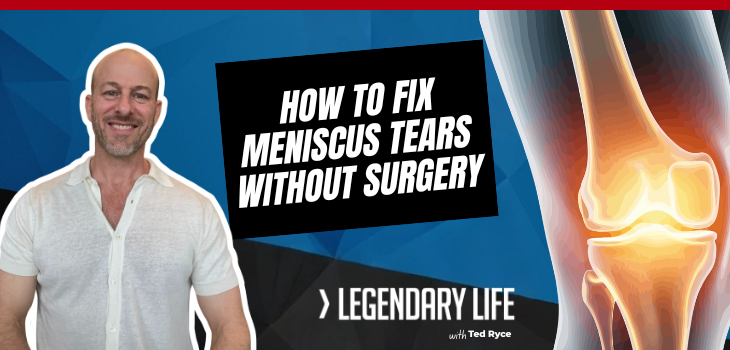
Been diagnosed with a meniscus tear and unsure whether to choose surgery, physical therapy, or both?
In this episode, Ted explains how meniscus tears happen, why tear location matters, when surgery may be appropriate, and how a progressive rehab plan can help men over 40 return to the activities they love.
You’ll learn:
- Why meniscus tear location matters when deciding between rehab and surgery
- The difference between degenerative and acute meniscus tears
- When physical therapy may be the best first step for knee recovery
- Why surgery still requires a proper progression back to strength, sport, and activity
Chapters:
(00:00) Introduction
(00:50) Meniscus Tear Options
(02:26) What the Meniscus Does
(03:44) Degenerative vs Acute Tears
(06:14) Tear Location Zones
(08:08) Physical Therapy Path
(09:35) R3 Restore Rebuild Return
(11:14) When Surgery Makes Sense
(12:10) Surgery Types Explained
(13:41) Rehab Is Nonnegotiable
(14:38) Wrap Up and Next Steps
Related Episodes:
668: The R3 Method: Why Surgery, Physical Therapy, and Peptides Didn’t Fix My Knees (But This Did)
Ask Ted: How to Train Smart with a Knee Injury (and Still Make Progress After 50)
How To Get Back in Shape and Train Smarter After an Injury
Links Mentioned:
Connect with Ted on X, Instagram, Facebook, LinkedIn
Podcast Transcription: The 3-10 Knee Method: Meniscus Tears: Is Surgery or Physical Therapy The Best Option? - Part 2
Ted Ryce: You've been diagnosed with a meniscus tear, and you're wondering, "What should I do? Should I go the surgery route? Should I get physical therapy? Should I do both? What's the best treatment?" And look, it's normal to feel unsure about what comes next if this is your case. I've worked with several people with meniscus tears.
I have a torn meniscus in my knee, and, uh, you're wondering, uh, do you really need surgery? Can physical therapy really fix it? And most importantly, what option gives you the best long-term outcome? Because we're gonna get into a little bit of the research today, and I'll do more on this later because there's just more and more research coming out comparing surgeries to all types of things, uh, conservative care to even fake surgery.
We'll get into that in another episode. But before we dive in, my name is Ted Ryce. I'm an executive health coach for men over 40, especially if you're dealing with injuries. So let's get into it. The good news is that we've never been more clear about the answers than before. And for many people, the research shows surgery isn't needed.
It really depends. So if you're looking for information on what best, uh, what the best thing to do is for meniscus tears, I really wanna help you understand your options so you can make an informed decision. So first of all, what is the meniscus? Well, you have two of them. You have the medial and the lateral menisci, and they're two C-shaped cartilage structures that sit in between your t- shin bone, your tibia, and your thigh bone, your femur.
So where those two bones come together, there's these two C-shaped cartilage structures on each side. The lateral is the outside, the medial is the inside. And what they do is they act like a shock absorber. So, uh, whenever you're walking, running, jumping, they help to absorb the shock from that pressure that happens during those activities.
And it also helps distribute the load more evenly across the knee joint, and it reduces stress on the articular cartilage, so the cartilage surrounding your bone, and also the bone, and it helps improve knee stability as well. And so when you have damage in that area, your knee's ability to absorb, uh, shock and manage stress, i.e.,
activity, playing sports, lifting weights, that's where the symptoms often appear, right? So there's two types of meniscus tears. One is degenerative, the other is acute, right? And, and these are generally where, you know, there's different types of tears, and we're not gonna get too into that. But It's either a result of, I don't wanna call it wear and tear, I really don't like that term.
I think it's misleading. It's like, "Oh yeah, uh, ju- the wear and tear." It's, a better way to say wear and tear is, it's like you've been using, you've been pushing your body inappropriately without proper recovery, and as a result of that, there's wear and tear in the joint. It's not just, "Oh, well, I'm 50. I've got wear and tear."
It's like, no, if you trained really well, you would, uh, be in better shape with less joint pain. But, you know, if you play sports or if you train like an idiot in the gym, or like me, I used to train like an idiot in the gym, you're gonna have some damage, and it's very common in people over 40. And there's often not a clear event that you can point to and say, "You know what?
That was when I tore my meniscus, and that's when all the problems started." It's really the degenerative type is more about long-term load and capacity and pushing the limits on a regular basis rather than a single traumatic injury. Now, the acute meniscus tear is different. It's more common in athletic individuals or if you're really out of shape.
Typically occurs when you plant and twist or pivot and something to- uh, tears, or if you're in a sport where there's high-velocity changes of direction. And, or, I should add this too, I hurt my meniscus when I was in jujitsu and a guy had me in a knee bar in training, and this was, like, my, my, you know, knee bars, you're probably unfamiliar.
It's a, a, a joint lock in, in Brazilian jujitsu where you hyper-extend the knee. And it was, like, kind of, kind of my signature move at the time. And this guy had me in it, and I was too... My ego said, "Don't tap. Just escape." And you know what? I escaped. I didn't tap. But I didn't win a medal 'cause it was in training.
Even if I would've won a medal and done it in competition, there was no money, right? And this is not my career. And so that's when, that's when I had my issue. So understanding which type of meniscus tear you have is really crucial on deciding which path to take. And so when you go to your doctor who you need to go to, right?
Like, if you have a, a problem with your meniscus or you suspect a problem with your meniscus, or maybe you saw a physical therapist, and they were like, "Yeah, well, it's just, you know..." It's really important to go to the doctor and get a diagnosis because where the tear is matters. So there's what's called the red zone, which is, like, the outer third of your meniscus, and it's got really good blood supply and the best healing potential.
And then there is the white zone, so that's the middle third, and it's got moderate b- blood supply, and it can heal, but, you know, it's not clear how well. And then there's the white zone of the meniscus So there's no direct blood supply there, and it really relies on joint fluid for nutrition, and through the process of called imbibition, which is just the mechanical pumping of movement that helps nutrients get in and out of the cartilage in that area.
So where the tear location is plays a major role on determining whether you should do physical therapy or maybe consider surgery because tears where the blood supply is good are much more likely to heal well with doing things like physical therapy. Tears in the red-white zone are s- they'll still often heal, is what the research says, but it depends on other factors like the direction of the tear and that type of thing.
But tears in the white zone have less healing potential, and it might be a case for surgery. So let's talk about physical, uh, therapy for meniscus tears. So if you got a degenerative meniscus tear, the first-line recommendation is physical therapy or what I do, post-rehabilitation training to get you to return back to the things that you love to do because often physical therapy isn't enough to get you pain-free, but then you, you know, go try to run or you go try to go back to playing golf or tennis or in my case, Brazilian jujitsu, and you end up with a inflamed knee again.
And, uh, so anyway, you need to have a progression that will get you back to that level, and that's what's shown to be as effective as surgery in many cases. For acute meniscus tears, you really gotta go to the doctor. You gotta figure out, okay, what type of tear is it? Where's the location? And do you have any mechanical symptoms?
For example, is your knee locked in the bent position? Because if you don't have significant locking or, you know, a blocked movement or severe mechanical catching, like you're like, "Wow, I can't extend my knee because it... there's like something in the way," then you really need to consider going to an orthopedic surgeon, getting an MRI to clarify the type of meniscus tear, the location of it.
All right? But make sure, again, you go to a phys-- uh, not a physical therapist. Go to a orthopedic surgeon. So what does physical therapy look like? Well, early stage, or what I call the restore phase, it's talking about, like, we're talking about lowering pain. We're talking about doing things to restore full knee range of motion, especially extension and knee straightening.
Uh, we're talking about progressively lower- uh, l- not lowering, loading and strengthening the muscles of the knee and the surrounding muscles of the hip and the ankle. We're also talking about balance training too, movement training, and, um, you know, that is where we start. Then we need to progress to the rebuild, where we get you starting to do some light plyometrics, jumping.
You need to get back to that, by the way. As a- like, for everyone, you need to get back to that, and you need to rebuild the strength in the muscle and the joint capabilities, the joint resilience, because that's how you're gonna avoid getting injured again, especially if you find yourself having to push your knee in a way that you didn't expect.
Because just saying, "Well, I'm never gonna run again," it's like, okay, well, what if you need to run and get your kid out of the way because he's running into the street? Or what if you have to run for some reason? You have to be more prepared, right? So that is the path. That's my, that's my R3... That's how I approach it, my R3 Knee Method.
And we also use supplementation and recovery modalities to help. Now let's talk about surgery. It can be-- It's really important to understand the trade-offs here because I'm, I'm gonna get more into this 'cause more and more s- uh, not surgery is coming out. More and more research is coming out on surgery comparing, like, fake surgery to real surgery.
I mean, like, it's really crazy the types of things that have been looked at. And, uh, so surgery can be appropriate. Again, you gotta see an orthopedic surgeon for this. If you're having severe mechanical symptoms, like you can't straighten your knee, or it's locked up, or, um, you know, you just keep trying to get back to your activity, and it...
Like, you need to understand, you know- Uh, let me, let's redo that again. So surgery can be appropriate in specific cases. Again, you gotta check with your orthopedic surgeon. If your knee is locked up and you can't straighten it, it's like, how do you get around that with just physical therapy? And there's a couple of types of different surgical approaches.
Partial meniscectomy. So in a partial meniscectomy, the damaged, damaged portion of the meniscus is removed. And while people often feel good short-term relief, uh, you do remove the m- the meniscus tissue permanently, and there's an association with increased long-term risk of knee arthritis. So you might feel better in the short term, might feel worse in the long term.
And then there's meniscal repair, and this is when the surgery attempts to stitch together the torn cartilage to try to preserve it all. And it's only possible for certain tear patterns and zones, but, um, you don't remove any cartilage, so there's better long-term joint preservation and a reduced risk of osteoarthritis compared to meniscectomies.
And it requires strict postoperative rehab. So that's a case where you do wanna see a physical therapist, uh, for that, like immediate, 'cause I don't deal with, um, like someone gets out of surgery, I'm not the person to call for that, right? I see you after you do that postoperative rehab. That's where I take you and, and get you back to.
But you gotta see a good post-op physical therapist after e- either of these surgeries really. And with the meniscal repairs, there is some risk of that repair failing, so the stitches coming undone or whatever, right? So that is it. You know, when we're talking about the We're talking about physical therapy.
I want to make something clear. That is the answer here, whether you have surgery or not. Surgery, even when surgery is the right decision, post-op rehabilitation and, like, return, the, the R3 method is what I use, again, to res- uh, restore, rebuild, and return. You gotta restore the range of motion and the strength.
Then you start to rebuild, uh, the joint tolerance and muscles to a greater degree, and then you eventually start doing some, uh, some jumping, some plyos, some change of direction drills. Because ultimately, if you wanna get back to doing the things that you love, running, jumping, playing golf or tennis or...
Right? You need a proper progression beyond just what your post-operative physical therapist does. And by the way, that is it for today, today's episode. If you are a high-performing man over 40, and you're struggling with some knee issues, whether it's a meniscus tear or something else, and you've tried a few things, and you're stuck in that rest-reinjury cycle where you're just not able to get back to doing the things that you love, let's have a conversation.
Go to legendarylifepodcast.com/knee. That's legendarylifepodcast.com/knee. Let's book a call. Let's have a conversation about your situation and talk about getting you back to doing the things that you love. That's it for me. Hope you learned a lot from this. Talk to you on the next episode.
Sign up to receive email updates
Enter your name and email address below and I'll send you periodic updates about the podcast.